
NAD+ Delivery Routes Compared: Shots, IV, Nasal, Patches and Oral Precursors, and Why the Route Argument Misses the Real Bottleneck
There is a step in NAD+ biology that decides this entire debate, and it happens after delivery and before anything useful occurs. NAD+ does not cross the plasma membrane. Whatever route puts it in the body, it gets taken apart at the cell surface and rebuilt inside. Once you know that, the ranking of injection against nasal spray against patch stops being the main question and becomes a smaller one.
Research-use-only disclaimer: NAD+ supplied as a research chemical is intended strictly for in-vitro and laboratory research use and is not intended for human or veterinary use in that context. Clinical and commercial delivery formats are discussed below because they are what the published pharmacokinetic literature describes. No dosing or administration guidance appears in this article, and nothing here is medical advice.

TL;DR
NAD+ is not a peptide. It is a dinucleotide of about 663 Da with no amino acids in it. It does not enter cells intact. Extracellular NAD+ is dismantled at the cell surface: CD73 cleaves it to NMN and then to nicotinamide riboside, CD38 and CD157 cleave it to nicotinamide, and those smaller uncharged pieces cross the membrane and get rebuilt into NAD+ inside. So every route ends at the same bottleneck. Evidence ranking: IV has the clearest pharmacokinetic rationale, oral precursors have the most human data, injection sits between them, and nasal sprays and transdermal patches have no measured human bioavailability figure at all. The widely quoted "10% oral, 100% IV" numbers are rules of thumb, not measurements. Research use only.
What it is: nicotinamide adenine dinucleotide, ~663 Da, charged and hydrophilic. Not a peptide.
The bottleneck: NAD+ cannot cross the plasma membrane and is degraded at the cell surface before uptake.
Enzymes doing the dismantling: CD73 to NMN then NR, CD38 and CD157 to nicotinamide.
Best pharmacokinetic rationale: intravenous.
Most published human data: oral precursors, particularly NMN.
No measured human bioavailability: nasal spray, transdermal patch.
Status: research use only.
NAD+ Is Not a Peptide
Worth clearing up first, because NAD+ sits in the peptide aisle at almost every supplier including this one, and the filing is commercial rather than chemical.
NAD+ is nicotinamide adenine dinucleotide. It is built from an adenine base, a nicotinamide group, two ribose sugars and two phosphate groups bridging them. Molecular mass is roughly 663 Da. There are no amino acids in it and no peptide bonds.
That distinction is not pedantry. It changes what you should expect from it. Peptides are degraded by proteases and their delivery problems are mostly about enzymatic attack and size. NAD+ has a different problem entirely, and it is about charge.
The two phosphate groups carry negative charge at physiological pH and the nicotinamide ring carries a permanent positive charge on its quaternary nitrogen. The molecule is very hydrophilic and very polar. Lipid bilayers exclude molecules like this almost completely, which is the single most important physical fact about NAD+ delivery and it is barely mentioned on the pages selling it.
The Bottleneck That Decides the Argument
Here is the part that reframes everything below it.
Blood NAD+ is not taken up by cells directly. It has to be converted into smaller uncharged molecules first.[1] That conversion happens outside the cell, catalysed by ectoenzymes sitting on the cell surface.
Two families do the work:
- CD73, a nucleotide phosphatase, cleaves NAD+ to NMN (nicotinamide mononucleotide), and can cleave NMN again to yield NR (nicotinamide riboside).[2]
- CD38 and CD157, glycohydrolases, cleave NAD+ to NAM (nicotinamide).[2]
NMN, NR and NAM are smaller and less charged than NAD+. They cross the plasma membrane, and inside the cell the salvage pathway rebuilds NAD+ from them: NR is phosphorylated to NMN by NR kinase 1 and 2, and NMN is converted to NAD+ by NMNAT enzymes.[1][2]
This reframing is not a reason to dismiss route differences. Getting more material into circulation still means more substrate arriving at the cell surface. It is a reason to be sceptical of any claim that one route delivers NAD+ "directly into cells", because none of them do, and that phrasing appears constantly.
It also raises a question I have not seen answered anywhere. If extracellular NAD+ is converted to NMN and NR before uptake, and NMN and NR are available as compounds in their own right, what is the argument for delivering the larger charged molecule rather than the smaller uncharged ones? There may be a good answer involving local concentration gradients or CD38 signalling effects. I have not found it stated clearly, and it is the first thing I would want addressed by anyone selling NAD+ on bioavailability grounds.
Intravenous Infusion
IV places NAD+ directly into circulation and skips absorption entirely. That is the clearest rationale of any route, and it is why IV is used as the reference point against which everything else is measured.[3]
The practical constraints are real. Infusions are typically slow, often measured in hours, and the reason given is tolerability rather than pharmacokinetics. There is also a delivery-rate question that follows directly from the bottleneck above: if surface enzymes are the rate-limiting step in conversion, flooding circulation faster than those enzymes can process the substrate does not obviously help.
What IV does not have is a large body of controlled outcome data. Bypassing absorption is a pharmacokinetic fact. Whether the resulting exposure produces better outcomes than a cheaper oral precursor is a separate question and it has not been settled.[3]
Injections, the NAD Shots Question
Subcutaneous and intramuscular injection sits between IV and oral. It bypasses the gastrointestinal tract and first-pass hepatic metabolism, and it does not require the time or supervision of an infusion.[3]
Injectable NAD+ has, in one description I think is fair, the strongest theoretical rationale for bioavailability and the least published clinical trial data among the main options.[3] Both halves of that sentence are worth holding onto. The theoretical case is genuinely good, because absorption from subcutaneous tissue into circulation is well understood for small hydrophilic molecules. The evidence case is thin.
There is a local-concentration wrinkle here too. Subcutaneous injection creates a depot with a very high local NAD+ concentration, and the tissue at that site is loaded with CD38-expressing immune cells. Whether a meaningful fraction of an injected dose survives long enough to reach systemic circulation as NAD+, rather than being converted locally, is a reasonable question. I have not found it measured.
PrymaLab supplies research-grade NAD+ in vial and preloaded autoinjector formats for laboratory use.
Nasal Spray
We sell an NAD+ nasal spray as research reference material, so I want to be direct about what the evidence looks like.
No published study has measured the bioavailability of intranasal NAD+ in humans.[3] Not a low figure, not a disputed figure. None.
The mechanistic case is also weaker than it is usually presented. The nasal epithelium absorbs small lipophilic molecules well and hydrophilic ones poorly, because the paracellular route through tight junctions is size and charge restricted. NAD+ is hydrophilic and carries charge. Those are exactly the properties that make paracellular passage difficult.
I covered the general mechanics of this route in the intranasal delivery reference, and the same limits apply here with one addition: for peptides the main constraint is molecular size, whereas for NAD+ the main constraint is charge. NAD+ is small enough by mass to sit comfortably inside the range where peptides permeate. It is the charge that argues against it.
Nasal delivery of NAD+ should be treated as unproven until somebody publishes a pharmacokinetic measurement. That is not a claim that it does nothing. It is a statement about where the burden of proof sits.
Transdermal Patches
Patches are the most heavily marketed of the newer formats and they have the weakest physical case.
The stratum corneum is a stacked lipid barrier evolved specifically to keep water and water-soluble things out. Transdermal drug delivery works reliably for small, lipophilic, potent molecules, which is why nicotine, fentanyl, scopolamine and oestradiol are the classic patch drugs. All of them are lipid-soluble and active at low doses.
NAD+ is the opposite of that profile on both counts. It is hydrophilic and charged, and the doses discussed are large rather than microgram-scale.[3]
No published pharmacokinetic study demonstrates that transdermal NAD+ reaches circulation at meaningful concentration.[3] Given the physical barrier and the molecular properties, that absence is what you would predict, and I would want to see a serum measurement before treating patches as a delivery route rather than a product category.
Liposomal and Sublingual
Liposomal encapsulation is a genuine pharmaceutical technology. Wrapping a hydrophilic molecule in a lipid vesicle can protect it from the gut environment and improve uptake, and the approach is well established for other compounds.
The problem in this category is consistency. Liposomal formulations vary widely between brands, and differences in manufacturing quality, particle stability and storage conditions produce unpredictable results.[3] A liposomal product is only as good as the vesicles in it, and vesicle integrity is not something a consumer or a researcher can assess by looking at the bottle.
Sublingual sits alongside it and shares the nasal problem. The oral mucosa is thinner and more permeable than skin, which is why sublingual works for some small lipophilic drugs. It faces the same charge barrier for NAD+, and no published study has measured sublingual NAD+ bioavailability in humans.[3]
Oral Precursors, NMN and NR
This is where the human data actually is, and it is the part of the field with the least marketing noise around it.
NMN and NR sit upstream of NAD+ on the salvage pathway. They are smaller, less charged, and they have dedicated transport routes into cells, which is the whole reason they work orally when NAD+ does not.[1][2]
Among oral options, NMN at 250 to 500 mg per day represents the best-available evidence-based approach to raising NAD+ levels.[4] That is a specific range from the clinical literature rather than a marketing figure, and it is the closest thing to a settled answer anywhere in this article.
Bioavailability of oral NMN and NR is meaningful but inconsistent between individuals, with conversion efficiency varying by gut health, age and genetics.[4] That variability is a real limitation and it is the honest counterweight to the point above.
NMN vs NAD vs NR, in one paragraph
Think of it as a pathway rather than a competition. NR is converted to NMN by NR kinase 1 and 2. NMN is converted to NAD+ by NMNAT enzymes. NAD+ is the end product and the working molecule. Supplying any of the three raises the pool, and the question is only which one crosses membranes most reliably. On that criterion the smaller upstream molecules win, which is an awkward result for anyone selling the end product on absorption grounds.
One more thing worth knowing. CD38 activity increases with age, and CD38 is one of the enzymes consuming NAD+.[2] That means the decline in NAD+ with age is partly a consumption problem rather than purely a supply problem, and adding more substrate to a system with rising consumption is a different intervention from fixing the consumption. The CD38 inhibition literature exists for exactly this reason and it rarely appears alongside the delivery-route discussion.
Why NAD+ Declines With Age, and Why That Changes the Strategy
The premise underneath this entire product category is that NAD+ falls with age and that raising it is therefore useful. The first half is well supported. The second half depends on something the marketing rarely addresses, which is why it falls.
There are two candidate explanations and they point at different interventions.
The first is reduced synthesis. NAMPT, the rate-limiting enzyme converting nicotinamide back into NMN in the salvage pathway, declines with age in several tissues. Less NAMPT means less recycling, and less recycling means a smaller pool.
The second is increased consumption. CD38 activity rises with age, and CD38 consumes NAD+.[2] It is not a small consumer either: CD38 is one of the principal NAD+-degrading enzymes in mammalian tissue, and its expression climbs alongside age-associated inflammation.
Those two mechanisms call for different responses. If the problem is supply, adding precursors is the obvious move and the logic of the entire NMN and NR industry holds. If the problem is consumption, adding substrate to a system that is degrading it faster is like topping up a tank with a bigger leak in it, and the more direct intervention is inhibiting the enzyme doing the degrading.
A CD38 inhibition literature exists for exactly this reason, and it almost never appears alongside the delivery-route discussion even though the two questions are connected. If CD38 is the dominant term in a given tissue, route optimisation is a second-order concern.
There is also an irony worth noticing here that follows directly from the bottleneck section. CD38 is one of the enzymes that dismantles extracellular NAD+ so it can be taken up. The same enzyme whose rising activity contributes to the decline is also part of the machinery converting delivered NAD+ into something absorbable. That is not a contradiction, since the reaction happens in different compartments and serves different ends, but it does mean the enzyme sits on both sides of the ledger and any simple story about it is probably too simple.
The Precursor Family, and Why Nicotinamide Is Not Nicotinic Acid
Four molecules feed the NAD+ pool and they are frequently used interchangeably in consumer writing when they should not be.
- NAM, nicotinamide. The amide form of vitamin B3, and the direct product of NAD+ consumption by CD38 and the sirtuins. It re-enters the salvage pathway via NAMPT. Does not cause flushing.
- NA, nicotinic acid. Also vitamin B3, also called niacin, but a chemically distinct molecule that enters through the Preiss-Handler pathway rather than the salvage pathway. Causes the well-known flushing response through prostaglandin release in skin.
- NR, nicotinamide riboside. Nicotinamide with a ribose attached. Converted to NMN by NR kinase 1 and 2.[1]
- NMN, nicotinamide mononucleotide. NR with a phosphate added. One step from NAD+ via NMNAT enzymes.[1]
The practical distinction that matters most: nicotinamide and nicotinic acid are not the same compound and do not behave the same way, despite both being sold as vitamin B3. They use different entry pathways into NAD+ synthesis, they have different effects at high intake, and only one of them flushes. Any source that treats "niacin" as a single thing is glossing over a real difference.
The distinction that matters second most is the one already covered: NR and NMN cross membranes and NAD+ does not. Everything in the delivery-route debate is downstream of that fact.
The 10 Percent and 100 Percent Figures
Almost every page on this topic quotes absorption of roughly 10 percent for oral and close to 100 percent for IV.[3] Those numbers deserve a paragraph of scepticism.
The 100 percent figure for IV is definitional rather than measured. Bioavailability is defined as the fraction of an administered dose reaching systemic circulation, and intravenous administration is the reference against which other routes are calculated. IV is 100 percent because that is how the scale is built, not because somebody measured it and found complete absorption.
The 10 percent figure for oral is harder to trace to a specific pharmacokinetic study of NAD+ itself, and it is often applied loosely across NAD+ and its precursors, which have different absorption profiles from each other.
Treat both as rules of thumb. They are directionally reasonable and they are not measurements you should build a comparison on.
What the Delivery Problem Looks Like In Vitro
Almost everything above concerns getting NAD+ into an organism. In cell culture the problem changes shape, and since that is what research-grade material is for, it is worth covering separately.
Adding NAD+ to culture medium does not raise intracellular NAD+ the way adding it to a test tube raises the concentration in the tube. The same barrier applies: the molecule sits in the medium, and cells carrying CD73 or CD38 on their surface convert it to NMN, NR or nicotinamide, which then enter.[1][2] Cell lines differ substantially in how much of those ectoenzymes they express, so identical treatment of two lines can produce very different intracellular results for reasons that have nothing to do with the compound.
That has three practical consequences for experimental design.
First, ectoenzyme expression is a variable that needs measuring rather than assuming. A line with low CD73 will convert extracellular NAD+ slowly and may show little intracellular change, and reading that as the compound being inactive would be a mistake.
Second, comparing NAD+ against NMN or NR in the same model is more informative than testing NAD+ alone, because the difference between them isolates the conversion step. If NR raises intracellular NAD+ and extracellular NAD+ does not, the bottleneck is at the surface rather than in the salvage enzymes.
Third, serum in the medium matters. Serum contains its own nucleotidases and its own NAD+ metabolites, so the effective exposure is not what you added. Serum-free or defined-serum conditions remove a confound that is easy to overlook.
None of this makes NAD+ a poor research tool. It makes it a tool whose behaviour depends on the model as much as on the compound, which is a useful thing to know before designing around it.
Side by Side
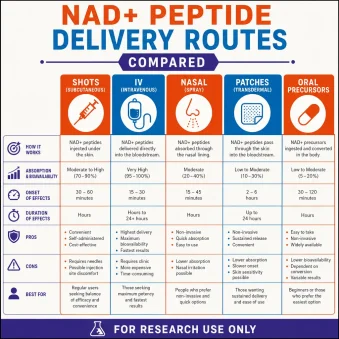
| Route | Bypasses | Main physical obstacle | Published human PK |
|---|---|---|---|
| IV infusion | GI tract, first pass, absorption entirely | None, but slow administration for tolerability | Reference route by definition |
| Injection (SC / IM) | GI tract, first pass | Local CD38 conversion at the depot site | Thin |
| Nasal spray | GI tract, first pass | Charge restriction at tight junctions | None |
| Transdermal patch | GI tract, first pass | Stratum corneum excludes charged hydrophilic molecules | None |
| Liposomal oral | Partially, gut degradation | Vesicle integrity varies by manufacturer | Limited and inconsistent |
| Sublingual | First pass | Same charge barrier as nasal | None |
| Oral NMN or NR | Nothing, but uses real transporters | Inter-individual variation in conversion | Best available |
What Research Has Not Established
No published study has measured intranasal, sublingual or transdermal NAD+ bioavailability in humans. Three of the seven routes above have no pharmacokinetic measurement at all, and two of those three are actively sold on absorption claims.
No published comparison establishes that any delivery route produces better clinical outcomes than another. The bioavailability advantage of parenteral routes is real at the pharmacokinetic level, and whether it translates into better outcomes than oral precursors is an open question.[3]
No published work quantifies what fraction of an injected NAD+ dose survives local conversion at the injection site, which follows directly from the bottleneck described earlier and is the most obvious unanswered question in the whole area.
What is well established: NAD+ does not cross the plasma membrane intact. CD73, CD38 and CD157 degrade extracellular NAD+ into transportable precursors. Those precursors are rebuilt into NAD+ by the salvage pathway. CD38 activity rises with age. Oral NMN at 250 to 500 mg per day has the best-supported human evidence for raising NAD+ levels. Those five facts are solid and they are enough to evaluate most claims made in this category.
How Research-Grade NAD+ Is Characterised
NAD+ is not analysed the way a peptide is. HPLC with UV detection is standard, since both the adenine and nicotinamide groups absorb strongly in the ultraviolet, and mass spectrometry confirms identity at 663 Da.
Two things are worth asking about specifically. The first is NADH content, since the reduced form differs by two hydrogens and behaves differently, and a certificate reporting only total nicotinamide dinucleotide is not distinguishing them. The second is hydrolysis products: NAD+ degrades to NMN and nicotinamide in solution, particularly at alkaline pH, so a preparation that has been in solution for a while may be partly precursor already. Given everything above about precursors being the transportable species, that is more of a curiosity than a defect, but you should know what is in the vial.
At PrymaLab, research materials are characterised with HPLC and mass spectrometry verification and independent third-party testing. No lot-specific figures are asserted in this general reference.
Frequently Asked Questions
Is NAD+ a peptide?
No. It is a dinucleotide of about 663 Da made from adenine, nicotinamide, two riboses and two phosphates. No amino acids, no peptide bonds.
Does NAD+ actually enter cells?
Not intact. It is too charged to cross the plasma membrane. CD73 cleaves it to NMN and then NR, CD38 and CD157 cleave it to nicotinamide, and those fragments enter and are rebuilt into NAD+ inside the cell.
Which NAD+ delivery route has the best evidence?
IV has the clearest pharmacokinetic rationale. Oral precursors, particularly NMN, have the most published human data. Nasal, transdermal and sublingual have no measured human bioavailability figures.
Do NAD+ patches work?
No published pharmacokinetic study shows transdermal NAD+ reaching circulation at meaningful concentration. The skin barrier excludes charged hydrophilic molecules, and NAD+ is both.
What is the difference between NAD+, NMN and NR?
Points on one pathway. NR converts to NMN via NR kinase 1 and 2, NMN converts to NAD+ via NMNAT. The upstream molecules are smaller and less charged, which is why they cross membranes when NAD+ does not.
Where do the 10 percent and 100 percent figures come from?
The IV figure is definitional, since IV is the reference point for calculating bioavailability. The oral figure is difficult to trace to a specific study of NAD+ itself. Treat both as rules of thumb.
Is NAD+ approved for human use?
Research-grade NAD+ here is laboratory reference material for research use only and is not approved by any regulatory authority.
References
- Rajman L, Chwalek K, Sinclair DA. Therapeutic potential of NAD-boosting molecules: the in vivo evidence. Cell Metabolism. 2018. Cell Metabolism
- Jablonska P, et al. New insight into extracellular NAD+ degradation: the contribution of CD38 and CD73. Journal of Cellular and Molecular Medicine. 2021. PMC8256368
- Comparative reviews of NAD+ delivery methods covering oral, IV, injection, nasal, sublingual and transdermal routes, and their published pharmacokinetic status.
- Clinical evidence on oral NMN dosing and NAD+ elevation.
- Evolving concepts in NAD+ metabolism. 2021. PubMed 33930322
Bioavailability figures quoted in the secondary literature vary widely and are frequently unsourced. Where this article describes a figure as unmeasured, that reflects an absence of published pharmacokinetic studies at the time of writing, 19 August 2026.
Final disclaimer: This article is an educational research reference about delivery routes and NAD+ metabolism. NAD+ supplied by PrymaLab is sold and studied for laboratory research use only and is not approved by any regulatory authority for human or veterinary use. Statements have not been evaluated by the FDA. Nothing here is medical advice, administration guidance, or a treatment claim.
Descriptions of clinical delivery formats refer to products and practices outside this catalogue and do not describe or support any use of research-grade material. Always verify the legal status of any research compound in your jurisdiction before purchase or use.